TL;DR: The drive-thru is the hardest place to take an order reliably. Engine noise, wind, accents, kids talking in the back seat: the speaker is a genuinely difficult environment. Voice ordering for restaurants is any system that lets a guest order by speaking instead of typing.
Introduction
The drive-thru is the hardest place to take an order reliably. Engine noise, wind, accents, kids talking in the back seat: the speaker is a genuinely difficult environment.
Voice ordering for restaurants is any system that lets a guest order by speaking instead of typing. It spans phone lines, smart speakers, mobile apps, and the drive-thru speaker. This guide focuses on the drive-thru, where the operational stakes are high and the technology requirements are demanding.
You’ll learn how the technology works step by step, why the drive-thru is such a hard place for voice ordering, and what questions to ask before committing to a system.
What Do People Mean by Voice Ordering for Restaurants?
“Voice ordering for restaurants” pulls in a genuinely mixed crowd of searchers. Some want phone ordering, where a voice AI answers inbound calls instead of a human. Others mean smart speaker ordering, using a voice assistant device to place a food order. A third group wants in-app voice, tapping a mic icon inside a mobile app to build an order hands-free. And a fourth group means the drive-thru speaker, where an AI takes orders from a car window.
All four are real. But they’re not equal.
The drive-thru has the hardest audio environment and the sharpest operational stakes, because every order happens live, with a car behind it, every shift. That’s what this guide focuses on. Hi Auto is currently drive-thru only, with no kiosk or phone ordering, so if that’s what you’re looking for, this guide won’t be the right fit.
Why the Drive-Thru Is Where Voice Ordering Is Hardest
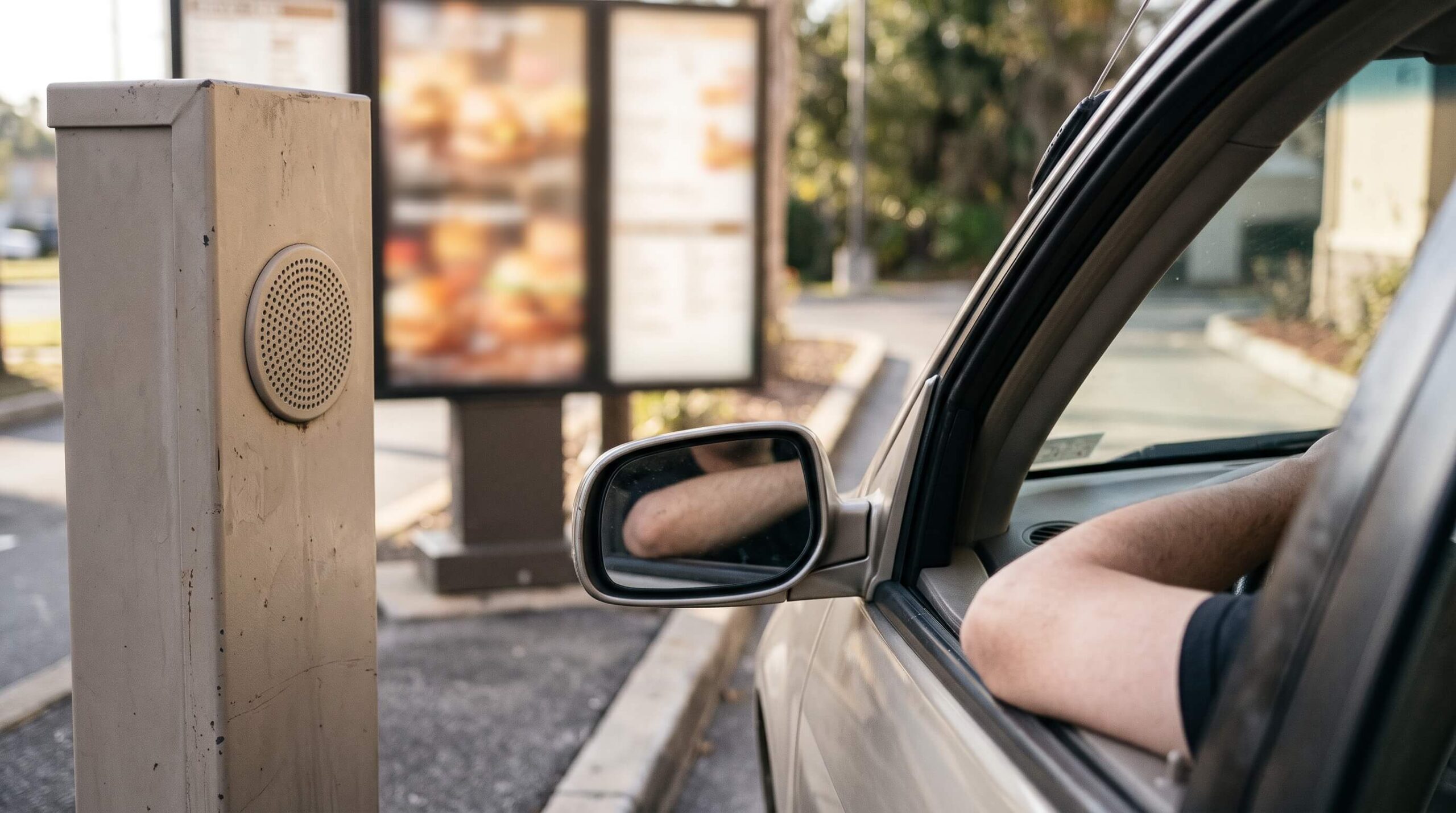
Think about the last time you used a voice assistant in a quiet room. Now put that same technology through an open window, with a diesel engine idling three feet away, rain hitting the roof, and a toddler calling out from the back seat. That’s the drive-thru.
The speaker post microphone doesn’t filter. It captures everything: road noise, adjacent lane conversations, wind, and whatever’s playing on the radio. Noise handling at this level is a hard engineering problem.
Here’s what the system has to handle on a single order:
- Multiple voices in one car. A parent orders while kids call out additions. The AI has to identify the primary speaker and hold the order state across interruptions.
- Mid-sentence corrections. A guest may change their mind mid-sentence, switching items, sizes, or modifiers. Order context has to update as the guest speaks without losing what came before.
- Modifier stacking. A guest may stack multiple modifiers on a single item in one breath.
- A live queue. There’s a car behind every car. A stalled conversation frustrates guests and costs throughput.
How Voice Ordering Works at the Drive-Thru, Step by Step
Most people picture a simple back-and-forth: you speak, the system responds. The reality at the drive-thru is far more layered. Here’s what actually happens between a car pulling up and the order reaching your POS.
- Vehicle detection. Sensors at the speaker post identify that a car has arrived. This triggers the system instantly. No button to press, no waiting for a crew member to notice.
- Greeting. The AI Order Taker greets the guest in an on-brand voice. Same tone, same energy, every order, every shift.
- Order capture. The guest speaks naturally. Automatic speech recognition (ASR) converts spoken words to text as the guest talks. It has to cope with open-air noise, regional accents, and the specific vocabulary of a QSR menu.
- Clarification. When an order is ambiguous, the system asks a follow-up: “Did you want that as a combo?” This is conversational AI managing dialog state, tracking context across the whole conversation so the AI knows what “that” refers to, even three items in.
- Upsell. The system can offer an upsell on every order where the operator enables it, based on factors such as order context and time of day. It is the operator’s choice, because an upsell does not always make sense.
- Confirmation. The AI reads back the order and total. The guest can correct anything before it’s finalized. The order confirmation board (OCB) runs alongside as a visual counterpart, showing the items the AI has taken so guests can verify without relying on audio alone.
- POS handoff. The confirmed order goes into your POS without a crew member re-entering it. Items enter the POS one by one as the guest speaks, on NCR Aloha and other POS systems.
Hi Auto’s average response time is 1.52 seconds. Voice AI also handles English and Spanish with automatic language detection, switching mid-order if needed, so a bilingual car gets served in the language each speaker chooses. See how multilingual ordering works in practice.
The Technology Behind the Conversation
Three technology layers work together every time a guest speaks at the order point.
Automatic Speech Recognition (ASR) converts spoken audio into text as the guest speaks. The catch: ASR that works in a quiet room can struggle outdoors, with engine noise, accents, and menu-specific vocabulary that a smart speaker never has to deal with.
Conversational AI and natural language processing take that text and find the meaning. This layer tracks the full order state, handles mid-sentence corrections, and manages modifiers across a multi-item order.
Text-to-speech (TTS) closes the loop, generating the AI’s spoken responses in a consistent, on-brand voice.
Each layer has to work well for the order to come out right.
Why It Matters for Operators
The “how it works” part is interesting. The “why it matters” part is what actually moves the needle for your business. Here are four concrete places where drive-thru voice ordering changes the math.
- Crew relief at the hardest station
Order taking is one of the hardest drive-thru stations to staff. When the AI handles the speaker, your crew stops juggling headsets, food prep, and the guest at the window all at once. Linda Ronda, Store GM at Checkers, said in the “Hi Auto | Checkers Video” (2025):
“Before we used to have to stress on trying to run to the front and answer the speaker for the guests and ring up orders and stuff but now we can do other things and be able to say and still pay 100% attention to the guests at the window.”
That shift, from juggling the headset to giving guests full attention, is where the real labor value lives.
- An upsell offer on every order, at the operator’s choice
The system can offer an upsell on every order where the operator enables it. The operator decides, because an upsell does not always make sense.
Offered consistently, that adds up across hundreds of orders a day.
- Bilingual service without crew intervention
Auto-detect and mid-order switching between English and Spanish means guests are served in their preferred language from the first word. Crew members don’t need to translate. For locations in bilingual markets, that helps both the guest experience and labor efficiency.
- Orders go straight into your POS
The order goes into your POS without a crew member re-entering it, which cuts down re-keying mistakes. See the list of POS systems on Hi Auto’s partners page.
What to Look for in a Drive-Thru Voice Ordering System
Not all voice ordering systems are built the same. Before you commit to a vendor, here are five questions that separate real-world performance from a polished pilot demo.
- Does completion AND accuracy hold at scale?
This is the one that trips most operators up. A vendor might show you a strong completion rate from a small pilot run in controlled conditions. That number rarely survives contact with hundreds of locations, diverse accents, and complex menus. Ask for completion AND accuracy figures across a large, live deployment. For reference, Hi Auto reports 93%+ completion and 96% accuracy across more than 1,000 stores. If a vendor can’t show you both numbers at scale, keep asking.
- Who sets up and maintains your menu?
Ask who sets up new menu items and limited-time offers. At Hi Auto, the Hi Auto team sets up new menu items and complex changes such as new LTOs, and simpler changes go through POS automation.
- Does the order flow directly into your POS?
The order should reach your POS without a crew member re-entering it. Ask which POS systems are supported. Hi Auto integrates with Genius by Global Payments (formerly Xenial), NCR Aloha, Lucas, PAR Brink, Oracle MICROS Simphony, Focus and Qu.
- What does deployment actually look like?
Ask for a realistic timeline, not a best-case one. A reasonable benchmark: pilot live in approximately 8 weeks, full chain rollout in 90-120 days. Anything vague here is worth probing.
- Does it handle Spanish without crew intervention?
If your trade area includes Spanish-speaking guests, ask whether the system auto-detects language and switches mid-order. Multilingual ordering should be built in, not bolted on.
For a plain-language definition of the technology, see the Voice AI glossary entry.
Completion Rate vs. Accuracy: Why Both Numbers Matter
Most vendors lead with one number. That’s where the conversation gets slippery.
Completion rate is the percentage of orders sent to the POS without staff intervention. Accuracy is the percentage of orders sent to the POS with every item and customization exactly right. These are two different things, and you need both.
A system can post a high completion rate while quietly getting orders wrong: the kitchen gets a medium instead of a large, or no pickles becomes extra pickles. A system can also hit strong accuracy on the orders it completes, yet complete too few of them for the accuracy figure to mean much.
The benchmark worth holding vendors to: strong completion AND high accuracy, both measured at scale across hundreds of live stores, not a controlled pilot. That “and” is the part that matters. One number without the other is a half-answer, and half-answers are expensive at the drive-thru.
The Question Every Operator Should Be Asking
Voice ordering for restaurants is real. The technology works.
The sharper question now: does the system you choose hold up at the speaker, on every order, across every store in your portfolio? Not in a controlled pilot. Not at your best location. At all of them, every shift.
José Armario, CEO of Bojangles, said at the QSR webinar “AI Order Taker That Works: The Bojangles Model” (July 2025): “The beauty of this technology is that we haven’t missed a beat when it comes down to the ability for this technology to interact as friendly, as effective, as efficient as a human person.”
The operators seeing real results ask whether it works with their menu, in their noise environment, with their guests. That is the bar.
If you’re ready to evaluate drive-thru voice ordering against that bar, the Buyer’s Guide: AI for the Drive-Thru gives you the framework, with a clear checklist of the five capabilities that separate systems that hold at scale from those that don’t.
Conclusion
Drive-thru voice ordering is running in production today: Hi Auto processes 100M+ orders per year across more than 1,000 stores. Knowing what to ask, and which benchmarks actually matter, is how you avoid a costly mistake.
Ready to Evaluate Drive-Thru Voice AI for Your Stores?
The Buyer’s Guide ‘AI for the Drive-Thru’ walks you through every evaluation question, from completion rates and accuracy benchmarks to POS integration and deployment timelines. Download it free.