

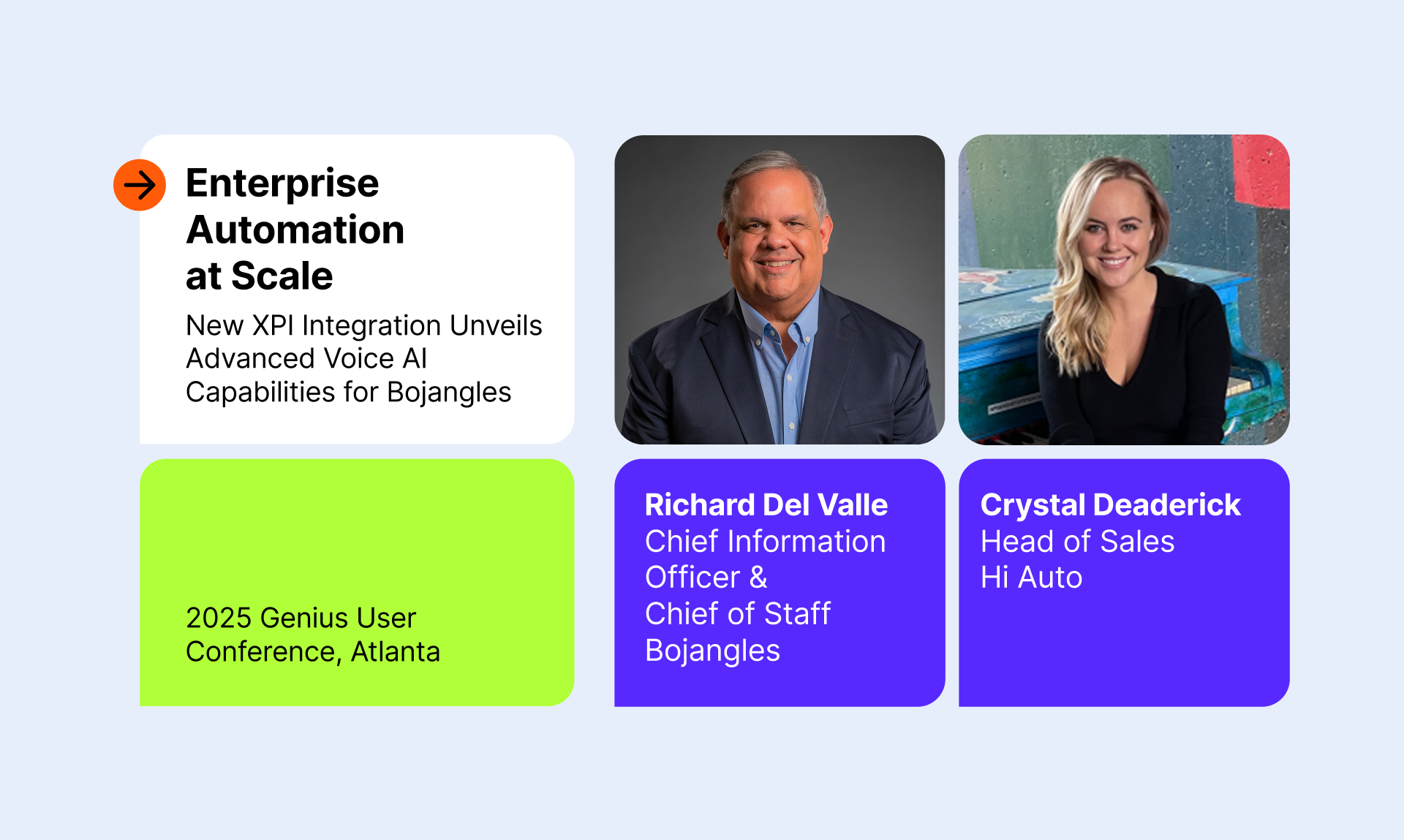
Fast-food automation has long been discussed in hypothetical terms: someday, AI will streamline labor, eliminate errors, and boost throughput. At the Global Payments Genius Conference, that future arrived with a very different tone. Bojangles and Hi Auto didn’t talk about theoretical models or pilots. They presented an active system operating across almost 500 restaurants, backed by hard performance data, and entering a new phase of capabilities driven by Genius’ latest XPI integration.
The project wasn’t greeted with cautious curiosity. It was greeted with surprise because many leaders in the room assumed that real-time, enterprise-grade Voice AI tied directly into the POS was still years away.
Instead, it’s here, scaled, and reshaping how drive-thrus work at the operational level.
The restaurant industry didn’t lack ambition around automation; it lacked the infrastructure that could support it.
Traditional POS API systems were built for web-based ordering workflows where latency is tolerable. Voice AI in a drive-thru has no tolerance for delay. Each second causes friction. Each failed handoff becomes a bottleneck.
The Genius XPI implementation addressed this directly, extending enterprise-grade reliability and architecture to a real-time interface between the POS system and Hi Auto’s Voice AI.
Executives at the event admitted they assumed the barrier to innovation was technological sophistication. What became clear is that the barrier was stability at scale, particularly in a distributed network of hundreds of locations.
Hi Auto’s platform, used by Bojangles as “Bo Linda,” doesn’t position itself as a novelty, but instead as an operational infrastructure.
The system injects items into orders one by one, displaying them simultaneously on the drive-thru screen and kitchen screens. Guests see changes as they speak. Staff begin prep before the order is finished.
The gain is not abstract. When preparation starts earlier, the line moves faster. Throughput increases, error corrections drop, and the cycle resets more efficiently.
Dual-lane drive-thrus, a common source of congestion, also receive a practical solution. Each order includes an image of the car that placed it, enabling staff to verify placement instantly when lanes merge.
This is not AI forcing the restaurant to adapt. It’s AI adapting to how restaurants actually run.
Local data routing is another key feature. Rather than relying solely on cloud connectivity, the system routes data locally to avoid latency or outages. Restaurants don’t lose performance when a network hiccup occurs; service keeps moving.
Many franchised systems have run ambitious tech pilots that never progressed beyond proof of concept. What matters most in QSR is operational certainty.
As the Bojangles deployment expanded from 100 to 300 to nearly 500 locations, two metrics held steady:
These results didn’t sell innovation. They sold predictability.
Franchisees didn’t adopt because they wanted to be early adopters. They adopted because performance didn’t degrade as the system scaled, and because it made the stores more efficient, not more complex.
For years, conversations about drive-thru AI focused on natural language handling. But the market is shifting toward a different standard, enterprise-grade performance tied to core systems.
The Genius–Hi Auto collaboration illustrates that Voice AI is no longer a specialty tool, but a mission-critical system that must optimize:
The emphasis has shifted from replacing humans to giving restaurants capabilities that humans alone cannot consistently execute at scale.
Founded in 2019, Hi Auto develops Voice AI specifically for high-volume drive-thru environments, powering roughly 1,000 locations across the U.S., U.K., New Zealand, and Australia. Its centralized system manages voice scripts, upsells, and ongoing optimization, while enabling brands to adjust menus, promotions, and regional variations with speed.
The most striking outcome from the Genius Conference wasn’t enthusiasm for future potential. It was recognition that expectations have changed.
Once a system demonstrates reliable, real-time performance across hundreds of restaurants, the question shifts from “Will automation work?” to “Why are we still operating without it?”
In a business where margins are thin and complexity compounds effortlessly, innovation that removes friction isn’t a trend. It’s a competitive necessity, and the starting point for everything that follows.
Featured in:

We use cookies and similar technologies to improve your experience, understand usage, and support marketing. By clicking “Accept,” you agree to our use of cookies as described in our Privacy Policy.