TL;DR
- Automatic speech recognition (ASR) is the first and most fragile layer in drive-thru voice AI. If it mishears the order, nothing downstream can fix it.
- The drive-thru is a harder listening environment than a quiet room: open windows, traffic noise, multiple speakers, and guests correcting themselves mid-order.
- In-house ASR, built and tuned specifically for the drive-thru, can be retuned per brand and region. Third-party ASR can’t be fixed at the source.
- Hi Auto’s in-house ASR supports 93%+ completion and 96% accuracy across roughly 1,000 stores.
- Ask any ASR vendor whether the ASR is owned or licensed, how it’s tuned, how it’s measured, and what happens when recognition fails.
Every drive-thru voice AI demo sounds the same. Smooth turn-taking, a friendly voice, an order confirmed in seconds. What almost nobody in the room asks about is the layer underneath the conversation, the one that has to hear the order correctly before anything else can happen.
That layer is automatic speech recognition, or ASR. It is where drive-thru voice AI actually succeeds or fails, and it is the part buyers understand least. Once you know what to look for, it is also the fastest way to tell a serious vendor from a repackaged one.
Automatic speech recognition, in two sentences
Automatic speech recognition is the technology that converts spoken audio into text a computer can process. In a drive-thru order taker, it is the first step. Everything downstream, understanding the order and responding to the guest, depends on ASR getting the words right first.
That is the definition. The interesting part is why getting it right at a drive-thru is a different problem than getting it right anywhere else.
Why the drive-thru is the hard case
Generic ASR is a largely solved problem in a quiet room. A voice assistant on a countertop, a call center headset, a conference room microphone: these are hermetic environments. One speaker, close to the mic, a controlled acoustic space.
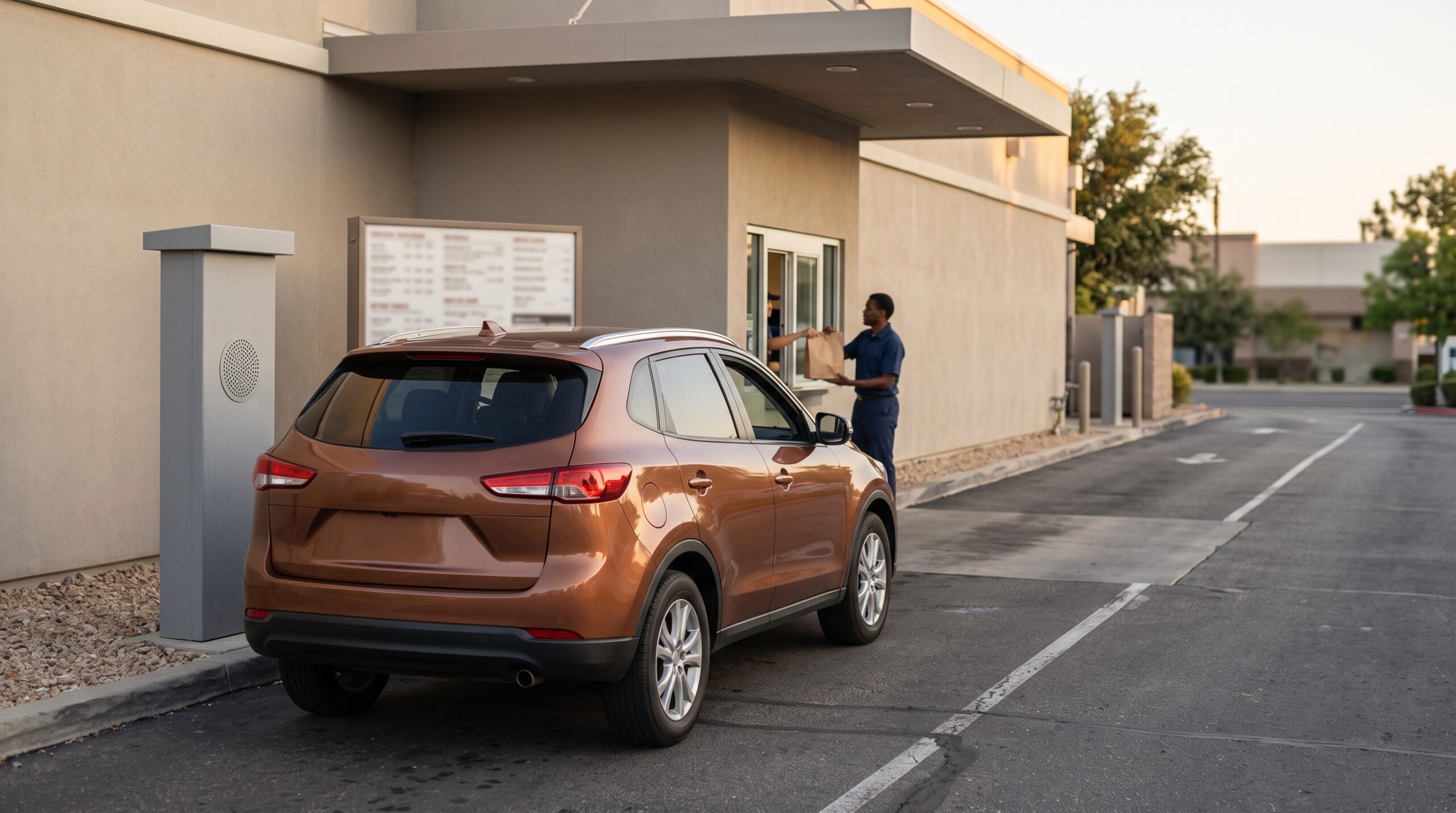
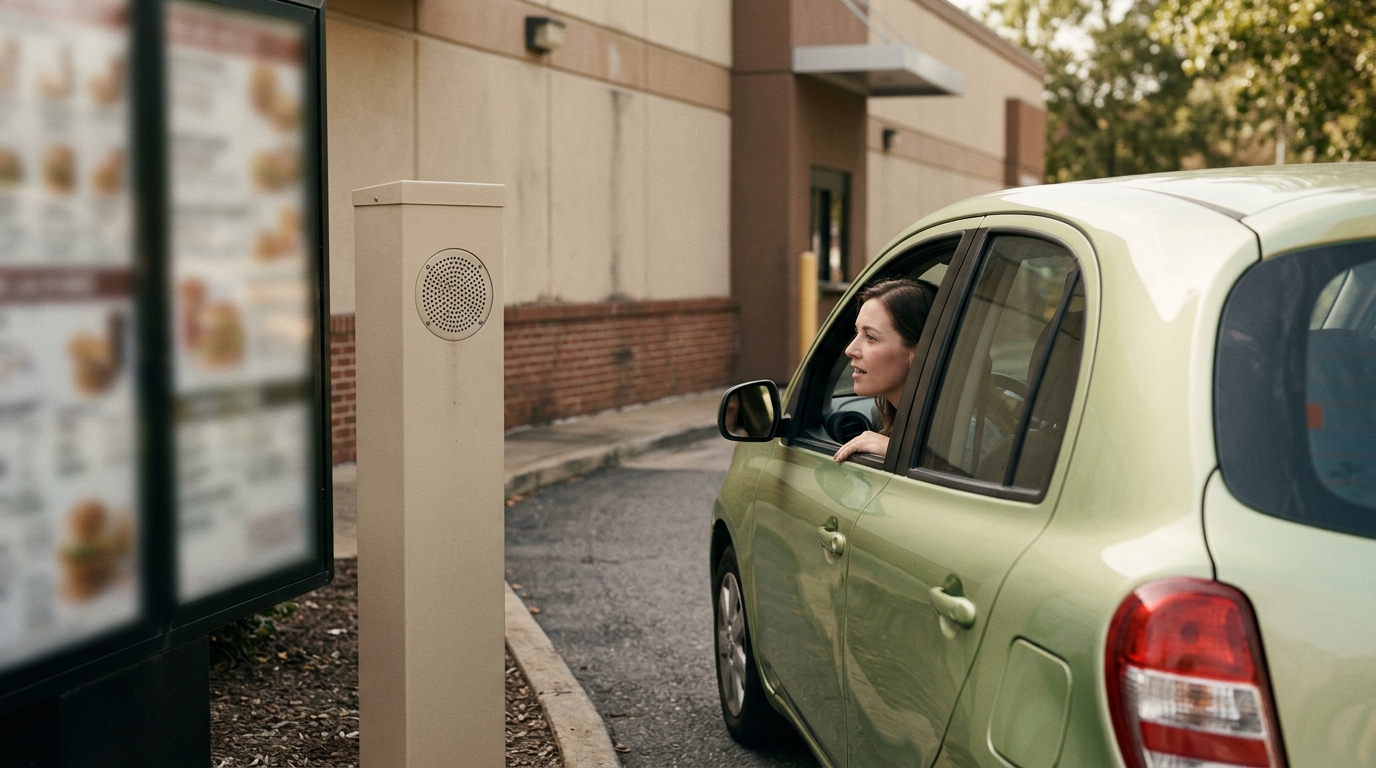
The drive-thru is none of that. The window is open. Traffic passes on the street behind the car. The lane next to it has its own speaker playing its own order. A passenger in the back seat shouts a change over the driver’s shoulder. The guest’s mouth might be six inches from the microphone or six feet, depending on the car and where they’re sitting.
Many voice AI systems marketed for drive-thru were built first for a different setting entirely, then adapted. That shows up exactly where it matters: recognition accuracy in real acoustic conditions, not in a demo booth. The windows-open problem is the heart of evaluating any drive-thru ASR, because it is the condition every other claim has to survive.
The variables that actually break recognition
A handful of specific variables separate an ASR system that holds up in the lane from one that only holds up in a pitch deck.
Accents and regional dialects. A model trained mostly on one accent pattern degrades on others. This matters more at a drive-thru than almost anywhere else, because a chain with locations across regions, or across countries, hears a wider range of accents and dialects in a single day than most voice applications ever encounter.
Multiple speakers. One car, several voices. The driver orders, a passenger adds something, a kid in the back changes their mind. Good ASR has to track who said what without losing the thread.
Mid-order corrections. Guests change their minds constantly. “Actually, make that a large.” The system has to catch the correction in real time, not just the original line. This is closely related to what the industry tracks as user correction rate, how often a guest has to repeat or fix themselves before the order is right.
Menu-specific vocabulary. A general-purpose speech model is unlikely to have been trained on “no pickles, extra Cajun on the side” or the shorthand a regional chain’s regulars use. Menu terms, sizes, and modifiers are specialized vocabulary that has to be learned, not assumed.
Ambient noise that changes by daypart and weather. A quiet suburban lane at 10am is a different acoustic environment than a rush at noon in the rain with three lanes running. ASR that performs well in only one of those conditions has solved a slice of the drive-thru, and the rest of the day is where that shows.
Operators who have run a drive-thru on unreliable order-taking technology describe the difference plainly. As Ryan Weaver, CEO of Lee’s Famous Recipe Chicken, put it:
“We have a really good partner that we work with for several years and they’ve got kind of in my opinion a best-in-class product which just handles that order taking process force of the drive-thru consistently with very high accuracy metrics.”
Ryan Weaver, CEO, Lee’s Famous Recipe Chicken. Nift “Marketing Bites: Restaurant Growth Unwrapped” podcast, Ep. 32, 1 April 2025. Watch the clip
That is what “holding up in the lane” looks like from an operator’s chair, not a demo room.
In-house ASR versus third-party ASR
Here’s the distinction that matters most to an IT leader evaluating vendors: does the vendor own its speech recognition, or is it reselling someone else’s general-purpose ASR wrapped in a drive-thru interface?
The difference isn’t cosmetic. A vendor that owns its ASR can retrain and retune it against real drive-thru audio, a specific brand’s menu, and a specific region’s accents. A vendor reselling third-party ASR is limited to whatever that provider ships, on whatever timeline that provider sets, tuned for whatever use cases that provider prioritizes, which usually aren’t drive-thrus.
Hi Auto’s approach is in-house audio filtering and ASR, developed specifically for the drive-thru environment and tuned per brand and per geographical region. That ownership is what lets recognition problems get fixed at the source rather than worked around.
The proof is in the outcome numbers, not a comparison chart. Across roughly 1,000 stores, Hi Auto holds 93%+ order completion and 96% accuracy. It handles English and Spanish, auto-detecting and switching mid-order when a guest does. Those are the numbers that carry the argument, because they are what a purpose-built, brand-and-region-tuned ASR actually produces at scale, not a claim about beating a specific benchmark.
What to ask an ASR vendor
A useful evaluation doesn’t start with the demo. It starts with these questions.
- Is the ASR yours? Built in-house, or licensed from a third party and wrapped?
- How is it tuned for our menu and our regions? Generic tuning, or brand-specific and region-specific?
- How do you measure recognition, and on what sample? A curated demo clip, or real drive-thru audio across dayparts, weather, and store types?
- What happens when recognition fails? Every ASR system misses a word sometimes. The honest answer describes what happens next, not a claim that it never happens.
That last question is where the built-in real-time fallback matters. Hi Auto is transparent that when confidence is low, a human steps in to complete or correct the order in real time. That transparency is a deliberate design choice, and it is what helps completion and accuracy hold up at scale rather than degrade whenever recognition hits a hard case.
The stakes of getting this wrong are visible in independent data. Reporting on the 2025 QSR Drive-Thru Report, Restaurant Dive (Aneurin Canham-Clyne, 2 October 2025) and QSR Magazine (Danny Klein, 1 October 2025) found that an employee had to step into roughly 21% of orders at locations running voice AI. What triggered those interventions is exactly the territory this article is about: the system could not answer a question, could not comprehend a customization, or an item was out of stock. The same coverage found that about 34% of guests at those locations had to repeat their order, against a study average of about 22%. Recognition failures carry straight through the rest of the stack. They show up in whether the order gets completed at all, and in whether it is accurate when it does.
Where ASR sits in the wider stack
ASR is the first of three layers, not the whole system. Recognized text feeds natural language understanding, which interprets what the guest actually means, and that feeds the language model generating the response. A built-in real-time fallback sits alongside all three, covering the low-confidence moments any of them can hit.
Audio latency, how quickly the system processes what it hears, matters at every layer too. A recognition engine that’s accurate but slow still breaks the pace of a drive-thru lane. Speed and accuracy have to hold together, not trade off against each other.
The shift in thinking
Most buyers evaluate drive-thru voice AI by watching the demo. The better question is which lane that demo was recorded in. Was it a quiet lane on a calm afternoon, or the kind of lane your stores actually run: windows open, traffic behind the car, a rush at noon?
ASR is where the marketing stops and the acoustic reality starts. Ask about it directly, and ask for the conditions behind any number a vendor shows you.
Want the full evaluation framework, not just the ASR piece? Download the Buyer’s Guide: AI for the Drive-Thru for the complete matrix IT leaders use to compare vendors. For the technical definition and related terms, start with the automatic speech recognition glossary entry.